
Why Microsoft Sentinel Feels Noisy: It’s Not Volume, It’s Recon Blindness
Alert fatigue in Microsoft Sentinel is not caused by alert volume alone. It is a context and correlation problem. Read how reconnaissance-aware threat intelligence helps separate internet scanning noise from active exploitation activity to improve signal quality and reduce false-positive incidents.

Alert Fatigue Is a Context Problem, Not a Volume Problem
Microsoft Sentinel becomes operationally inefficient when low-confidence telemetry is escalated directly into incidents. The dominant source of this noise is internet reconnaissance activity, including mass scanning, opportunistic probing, vulnerability discovery traffic, and commodity bot behavior.
Reducing alert fatigue is not about removing data. It is about ensuring Sentinel only escalates signals that represent meaningful attacker progression rather than isolated events.
Reconnaissance-Aware Intelligence Improves Signal Quality
Reconnaissance-aware threat intelligence improves Sentinel by replacing static IOC evaluation with behavioral classification of attacker infrastructure. Instead of treating all IP matches equally, Sentinel gains context such as:
- reconnaissance infrastructure
- active exploitation activity
- exploit delivery systems
- CVE-driven campaigns
- reusable attacker infrastructure
This allows Sentinel to evaluate attacker behavior, not just IOC presence.
Stop Using IOC Matches as Incident Triggers
ThreatIntelIndicators should not directly generate incidents. IOC matches alone lack behavioral context and often represent benign scanning, shared infrastructure, or non-exploitative activity.
Instead, IOC data should be used for enrichment to evaluate whether external activity aligns with internal signals such as authentication anomalies, endpoint execution, repeated targeting patterns, exploit attempts, or payload staging behavior. Without this separation, Sentinel treats reconnaissance noise and active compromise attempts as identical signal classes.
Practicle example: IOC enrichment vs incident triggering
An IP address appears in a threat feed and probes a public VPN endpoint. In a naïve Sentinel configuration, this immediately triggers an incident.
In a tuned model, Sentinel only escalates when that same IP also correlates with repeated authentication failures across multiple accounts within a short time window, indicating credential spraying behavior rather than passive internet scanning. This shifts detection from IOC presence to behavioral validation.
Classify Reconnaissance Before Escalation
Enterprise environments are continuously exposed to internet-wide reconnaissance from scanners, botnets, crawlers, exploit validation frameworks, and opportunistic attackers. The challenge is not detecting reconnaissance, but identifying when it signals pre-exploitation activity.
Generic threat feeds typically treat all reconnaissance as equivalent malicious activity, which leads to high-volume, low-value incidents.
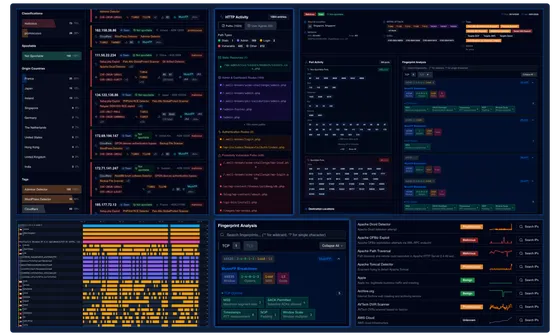
ELLIO Recon & Mass Exploitation Intelligence improves this by classifying attacker infrastructure in real time, including:
- internet-wide scanning infrastructure
- exploit validation against exposed services
- active mass exploitation campaigns
- exploit payload delivery systems
- CVE-targeted reconnaissance waves
- coordinated post-disclosure scanning activity
Practicle example: Recon noise vs exploitation context
Repeated TCP/443 and TCP/22 scanning from known internet-wide scanners can be safely rate-limited or dropped because they represent background reconnaissance. However, if the same firewall logs show traffic originating from infrastructure currently involved in an active exploitation campaign targeting VPN appliances or edge devices, that traffic is allowed through for Sentinel correlation.
With ELLIO context, Sentinel can suppress generic scanning while prioritizing exploitation-linked reconnaissance. This enables detection of CVE-driven waves, early exploit staging behavior, and correlation with internal authentication anomalies or endpoint execution events. Operationally, this reduces analyst fatigue significantly because incidents are generated from exploitation-aware telemetry rather than raw scanner volume.
Correlate Before Creating Incidents
Sentinel incidents should only be created when multiple signals indicate coordinated attacker behavior across reconnaissance, exploitation, and post-access stages.
Correlation should start at the intelligence layer rather than within isolated analytics rules. ELLIO Recon & Mass Exploitation Intelligence enables Sentinel to determine whether observed activity belongs to:
- early reconnaissance waves
- active exploitation campaigns
- isolated opportunistic scanning
This shifts detection logic from event-based rules to campaign-based interpretation.
Practical Example: Campaign-level correlation in Sentinel
During a global exploitation wave targeting a newly disclosed RCE in an edge device, multiple external IPs begin scanning perimeter services. Individually, these events are low-confidence.
ELLIO Intelligence identifies these IPs as part of an active exploitation cluster targeting the same CVE. At the same time, Sentinel observes authentication anomalies and unusual session behavior on exposed systems. Individually, none of these signals are sufficient. Combined, they represent a high-confidence exploitation chain and are escalated as a single correlated incident.
Without exploitation-aware intelligence, these signals remain fragmented and are unlikely to correlate.
Exploitation Signals Are More Valuable Than CVSS
Vulnerability severity alone does not reflect real attacker behavior. CVSS scores describe theoretical impact, not whether a vulnerability is actively being targeted in the wild. In practice, this leads to Sentinel environments over-prioritizing “critical” CVEs that are not being exploited, while missing lower-CVSS issues that are actively under attack.
Sentinel detection quality improves when prioritization is driven by observed exploitation activity rather than static scoring. This includes signals such as active exploit attempts against exposed services, repeated targeting of specific endpoints across multiple sources, payload delivery patterns, and infrastructure reuse across known attack campaigns.
Practical example: CVSS vs exploitation reality
A medium-severity vulnerability in an edge-facing service receives limited attention under CVSS-driven prioritization. However, ELLIO Intelligence identifies it as actively weaponized in ongoing campaigns with coordinated scanning and exploit delivery across multiple attacker clusters. When Sentinel simultaneously observes probing of that service and authentication anomalies, the activity becomes a high-confidence incident despite its moderate CVSS rating.
Conversely, a “critical” CVE with no observed exploitation activity or reconnaissance patterns in the environment remains low priority until real-world targeting emerges. This shifts Sentinel from theoretical risk scoring to observed attack execution.
Firewall-Level Filtering Reduces Upstream Noise
A significant portion of Sentinel alert fatigue originates from predictable perimeter traffic that should never reach the SIEM. This includes broad scanning, repetitive port sweeps, automated enumeration of non-existent services, and high-frequency probing from non-exploitative infrastructure. These signals add cost and noise without improving detection quality.
Firewall controls should target deterministic, low-value reconnaissance patterns while preserving visibility into meaningful attack behavior.
Practical example: IP-level noise vs exploitation-aware filtering
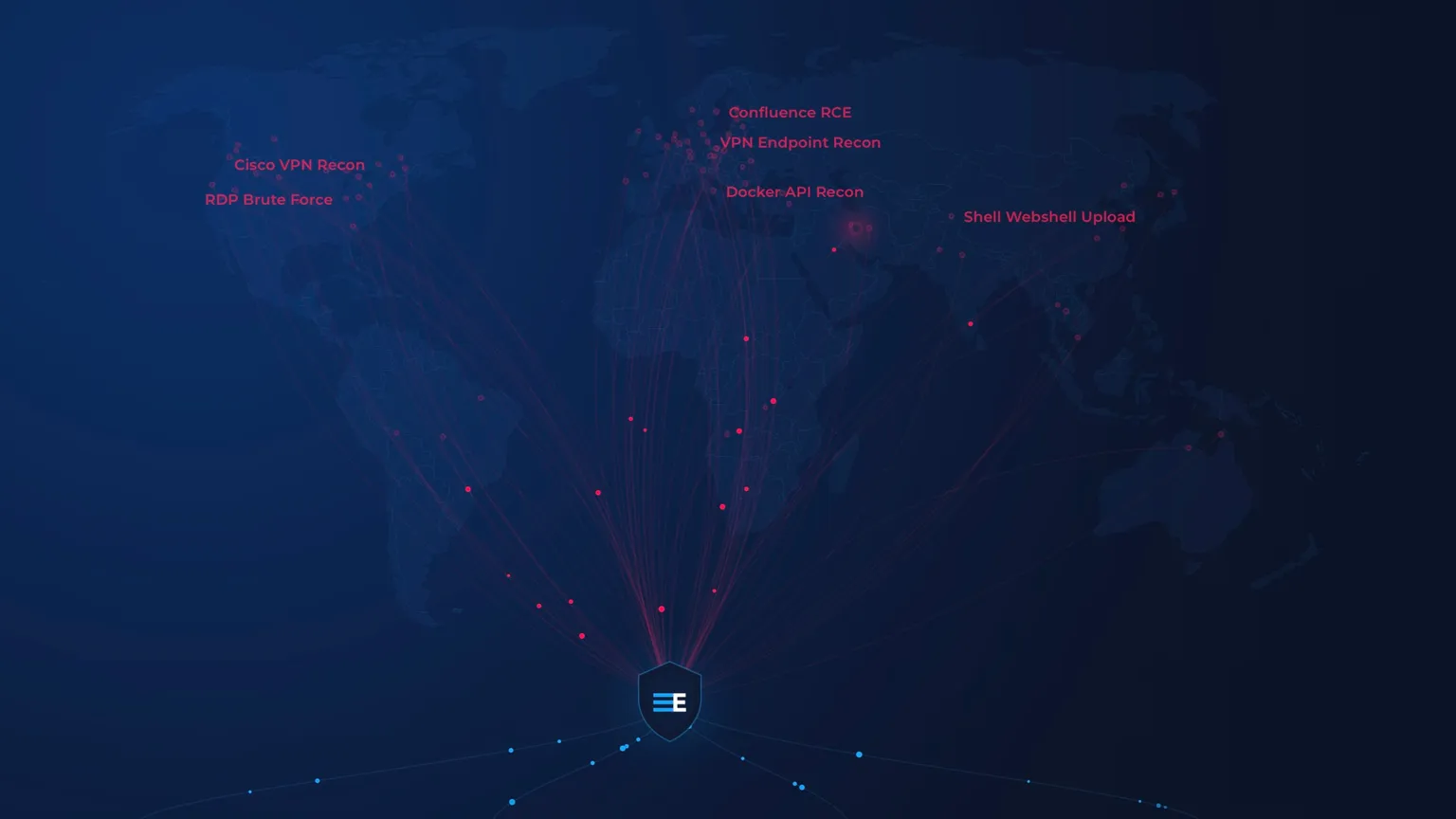
Repeated TCP/443 and TCP/22 scanning from known internet-wide scanners can be safely rate-limited or dropped because they represent background reconnaissance. However, if the same firewall logs show traffic originating from infrastructure currently involved in an active exploitation campaign targeting VPN appliances or edge devices, that traffic is allowed through for Sentinel correlation. This ensures that only low-value reconnaissance is filtered at the edge, while exploitation-linked activity tied to real campaigns is preserved for detection and investigation.
Conclusion
Alert fatigue in Microsoft Sentinel is not a volume problem - it is a context and correlation problem. The most effective SIEM noise reduction strategy is to:
- classify reconnaissance using real-time exploitation intelligence
- correlate signals at campaign level rather than event level
- suppress only low-value, non-exploitation scanning noise
- prioritize active exploitation over static IOC matching or CVSS-based scoring
- ensure suppression is controlled and reversible
Reconnaissance-aware intelligence - especially mass exploitation context such as ELLIO, enables Sentinel to distinguish background internet noise from meaningful attack progression.
The outcome is not fewer detections, but fewer irrelevant detections and significantly higher-confidence security incidents.
Written by

Jana Tom is the Founder of ELLIO, a cybersecurity research lab focused on understanding and defense against reconnaissance and mass exploitation activity on the internet.