
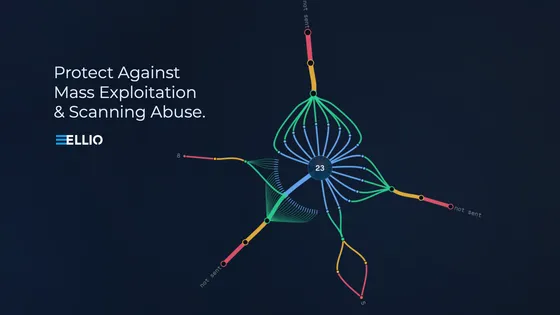
Recon is now high-frequency attacker behavior, not background noise.
Reconnaissance is no longer limited to pre-attack planning - it operates as continuous discovery infrastructure, expanding exposure visibility in real time, shortening targeting cycles, and overwhelming traditional response capacity and resources.

1. Reconnaissance is the lowest-cost stage to disrupt an attack.
After an incident appears, costs are already locked in: investigation, response, recovery, containment, and ongoing SIEM ingestion, storage, and analysis all add to operational overhead. Recon is the only phase where attack paths are still fluid and can be disrupted at low cost.
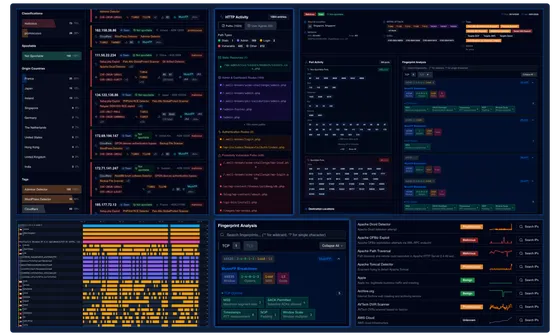
ELLIO detects, analyzes, and triages reconnaissance activity in real time, so threats can be stopped early before attack paths develop and costs grow. It also filters low-value scanning noise, reducing unnecessary investigation effort and lowering alert fatigue across security operations.
Cost to stop an attack
grows with every stage
2. Recon noise makes threat detection slower and resource-heavy.
Continuous Internet-wide reconnaissance creates a low signal-to-noise environment where relevant attacker activity is difficult to surface in time. It affects alert fatigue, triage volume, and investigation overhead across security operations.
ELLIO converts reconnaissance activity into structured threat intelligence, reducing noise at the source and enabling SOC teams to prioritize validated targeting earlier, improving triage efficiency and reducing operational cost.
Noise never reaches the queue. What’s left is worth an analyst’s time.
3. Generic 'malicious vs benign' labeling no longer works.
With growing Internet-wide scanning, the binary model breaks. The key question is no longer whether traffic looks malicious, but whether it represents unwanted reconnaissance against your defined attack surface.
ELLIO replaces this model with context-driven reconnaissance intelligence. Security teams define what reconnaissance means for their environment, and ELLIO identifies, analyzes, and classifies that activity in real time, aligning detection with actual exposure, assets, and risk rather than generic threat labels.
One source, two answers
- internet-wide
- seen nowhere else — probing only your ranges
- business service
- no IP Atlas match — not a crawler, CDN, or cloud
- behavior
- sequenced probes, low-and-slow
- against you
- VPN gateway :443 / :8443
4. Highly adaptive automation needs reliable data.
Humans, AI agents, and automation are only as effective as the data they operate on. SIEM logs, EDR alerts, and historical incidents alone keep security workflows reactive and resource-heavy.
ELLIO delivers live, contextualized ground-truth intelligence from real-time reconnaissance activity across the Internet. This external attacker context enriches SIEM and EDR data, enabling faster correlation of weak signals, earlier detection, and proactive identification of emerging risk.
The same event, with ground truth
no prior context — just another packet
- actor
- known from internet-wide recon since T−6 d · fp:9d42c1
- campaign
- mass exploitation prep · CVE-2026-31337
- targeting
- first contact with you — probing your VPN gateway
- verdict
- block — before the exploit attempt
SIEM, SOAR, and AI agents act on the first packet — not after the incident.