



The Intelligence Value of Network Fingerprinting
Two connections come from different IPs. Are they related? Network fingerprints give analysts another way to compare traffic, investigate suspicious activity and make decisions when reputation data offers few answers. But be careful: a fingerprint is only as useful as the interpretation behind it.
In this post, you’ll explore:
- The problem with treating an IP address as an identity
- What the fingerprint actually represents
- Correlation is a hypothesis, not a conclusion
- Where fingerprinting adds value to CTI
- The limitations matter as much as the match
- From a technical signal to an intelligence assessment
The problem with treating an IP address as an identity
An IP address is an observation, not an attribution.
Infrastructure is reused, cloud instances are ephemeral, and adversaries routinely change the systems through which they operate. Meanwhile, legitimate services can share hosting infrastructure with suspicious activity. An address may be valuable for blocking or enrichment, but its reputation rarely answers every question an analyst needs to resolve.
When investigating related activity across changing infrastructure, the more useful question is whether the connections share characteristics beyond their source addresses. This is where network fingerprinting becomes relevant to cyber threat intelligence. It provides a way to compare observable properties of network communications and determine whether those similarities warrant further investigation.
The distinction is important: fingerprinting does not establish who is behind a connection. It helps analysts evaluate whether separate observations may be related, then test that hypothesis against additional evidence.
What the fingerprint actually represents
The term network fingerprint covers several techniques, and their evidential value depends on what is measured.
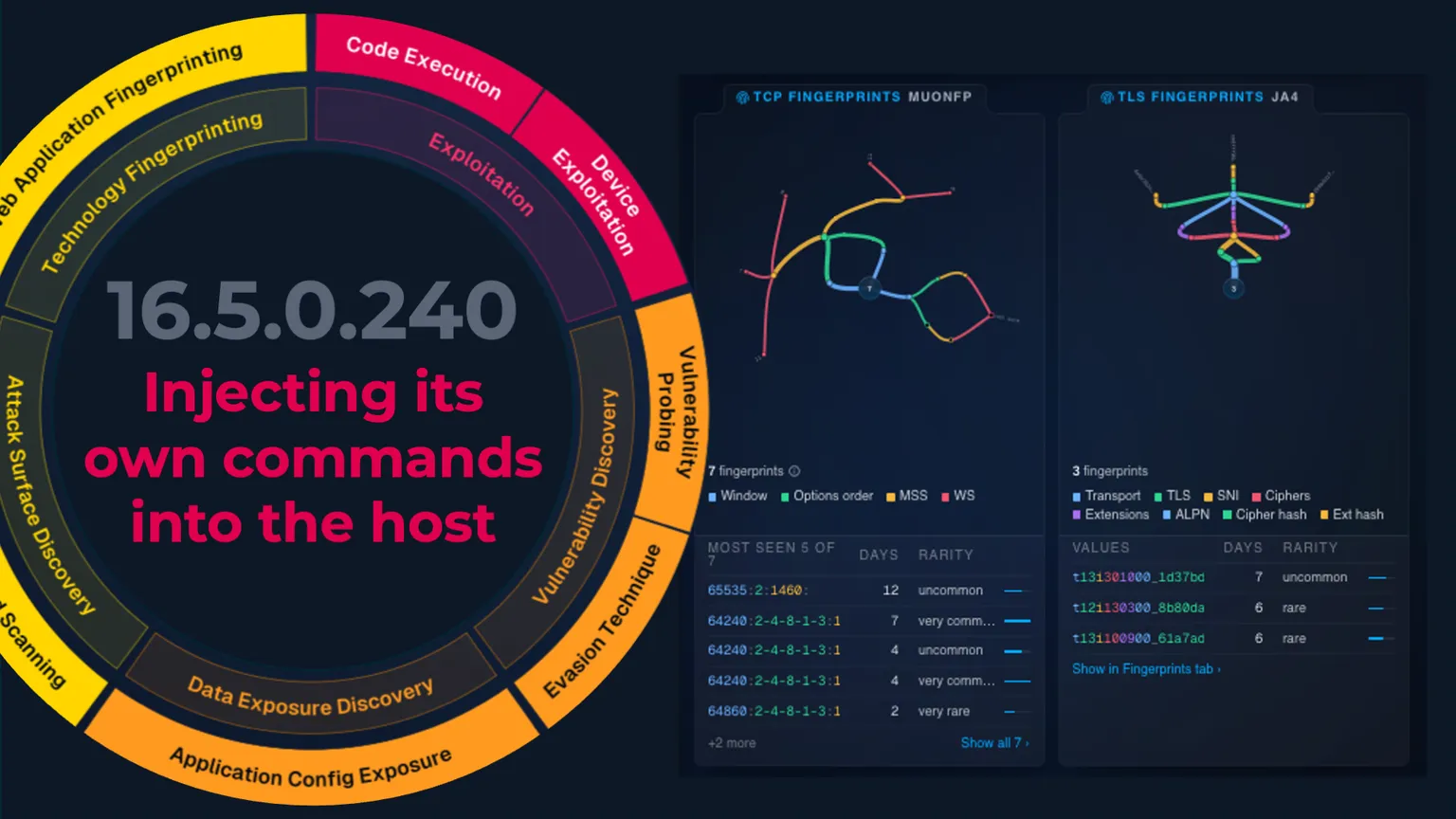
TCP fingerprinting examines characteristics of the TCP stack as exposed during communication. An initial SYN packet, for example, may reveal the advertised window, maximum segment size, window scaling, and TCP option ordering. These characteristics can provide clues about an operating system family, network implementation, or configuration.
TLS fingerprinting examines a different layer. JA3, JA4, and JA5 derive fingerprints from characteristics extracted from the TLS ClientHello, using different methods to represent TLS client behavior. These fingerprints help analysts compare TLS clients and identify patterns across connections, but none serves as a unique identifier for a host or operator.
The distinction between the two matters operationally. TCP characteristics can reflect the network stack that generates or modifies the TCP connection. TLS characteristics reflect the client handshake visible at the observation point. Proxies, TLS termination, middleboxes, software updates, and configuration changes can all affect the evidence available to the analyst.
A technically sound investigation therefore starts by understanding what a fingerprint measures, where it was observed, and which conclusions that observation can reasonably support.
Correlation is a hypothesis, not a conclusion
Consider a threat intelligence investigation involving suspicious activity from multiple IP addresses over several days. The addresses have limited reputation history, and the infrastructure appears to change frequently.
Comparing network fingerprints may reveal similarities between connections that would otherwise be investigated separately. That gives the analyst a reason to examine the observations together.
The next step is not to declare common attribution.
It is to test the relationship.
Do the connections share destinations, timing patterns, protocol behavior, request characteristics, or other infrastructure relationships? Do historical observations support the same hypothesis? Are there plausible benign explanations for the fingerprint match, such as a widely deployed software version or common client configuration?
A fingerprint match becomes more informative when independent observations converge. Conversely, a match that is common across unrelated systems may have little discriminating value.
This is the difference between collecting indicators and conducting threat intelligence analysis. The goal is not to find similarities for their own sake, but to determine whether those similarities meaningfully change the assessment.
Where fingerprinting adds value to CTI
Investigating infrastructure changes. When source addresses change, fingerprints can provide another comparison point across observations. They may help identify connections that deserve joint analysis, even when IP reputation offers little guidance. The result is a lead for investigation, not proof that the infrastructure shares an operator.
Enriching threat observations. A fingerprint can add technical context to an event or indicator. Depending on the technique and available telemetry, it may help characterize the client or network stack involved and support comparisons with previously observed activity.
Prioritizing investigation. Not every similarity deserves the same attention. A fingerprint that is common across ordinary clients may contribute little. A rarer, stable characteristic combined with consistent behavior and supporting infrastructure evidence may be more useful. Analysts should evaluate how distinctive a signal is within the relevant dataset rather than assume that every fingerprint carries equal weight.
Supporting asset investigations. In environments containing unmanaged devices, IoT equipment, or operational technology, network observations may provide clues where endpoint telemetry is unavailable. Fingerprints can contribute to device characterization, but should be combined with protocol behavior, communication patterns, passive asset discovery, and other available evidence before drawing conclusions about the device.
The limitations matter as much as the match
A fingerprint is only as useful as the interpretation built around it.
Different devices can share the same fingerprint because they use the same operating system, library, or software configuration. A single device can produce different fingerprints after an update or configuration change. Intermediaries may also change which characteristics are visible to the sensor.
These limitations have direct implications for intelligence assessments. A shared fingerprint alone cannot establish common ownership, identify a specific device, or demonstrate that activity belongs to a known threat actor. Nor does a mismatch necessarily rule out a relationship.
Analysts should distinguish observed facts from inferred relationships, assess alternative explanations, and seek independent corroboration before raising confidence in an attribution hypothesis. Where the evidence is insufficient, the correct conclusion is uncertainty, not a stronger claim.
This discipline also helps prevent weak indicators from spreading through intelligence reporting and downstream detection logic as if they were confirmed facts.
From a technical signal to an intelligence assessment
Network fingerprinting is most valuable when it changes the questions an analyst can investigate or the confidence with which a hypothesis can be assessed.
That requires more than extracting a fingerprint. It requires retaining the context of the observation, understanding the characteristics of the collection point, comparing relevant historical data, and assessing how distinctive the match actually is.
For a CTI team, the outcome should be a better-supported assessment: connections that merit correlation, infrastructure relationships worth examining, or a clearer understanding of what remains unknown. For a security operations team, the same evidence may help prioritize an alert or inform a response when combined with asset context and observed behavior.
The underlying principle is simple: network fingerprints are evidence about technical characteristics, not identities. Their strength lies in careful comparison and corroboration—not in the certainty implied by a matching value.
For threat intelligence, the question is not whether two connections have the same fingerprint. It is whether that similarity, considered alongside the rest of the evidence, meaningfully strengthens a defensible hypothesis.
See network fingerprints in action
Explore how network fingerprints support traffic analysis and threat investigations in the ELLIO Platform. Start your research at platform.ellio.tech and see how network-level evidence adds context when IP reputation alone isn't enough.
Written by

Jana Tom is the Founder of ELLIO, a cybersecurity research lab focused on understanding and defense against reconnaissance and mass exploitation activity on the internet.